
info@frameratetest.net New York, NY
100% Free No Sign-Up No Download
Frame Rate Test
Home
All Free Testing Tools 13 Tools
Frame Rate TestLive FPS graph and stress test
FPS TestTimed sessions, 1% Low, frame time
Refresh Rate TestAuto-detects Hz, up to 360 Hz
Mouse Polling Rate TestHz measurement, 8000 Hz support
Mouse DPI AnalyzerTrue DPI with deviation analysis
Mouse Scroll Wheel TestScroll direction and step accuracy
Keyboard TesterEvery key, ghosting detection
Spacebar ClickerCPS test, 6 timer modes
Gamepad TesterButtons, sticks, drift, vibration
Dead Pixel TestSolid color screens to find pixels
Dead Pixel FixerRapid color cycling repair tool
Display TestColor, gradient, uniformity check
Screen Bleeding TestBacklight bleed and IPS glow
All tools free, no download required Browse all
Display Tools
Frame Rate TestLive FPS graph with stress levels
FPS TestAdvanced session benchmark
Refresh Rate TestAuto Hz detection, up to 360 Hz
Dead Pixel TestFind stuck and dead pixels
Dead Pixel FixerColor cycling repair tool
Display TestColor, gradient and uniformity
Screen Bleeding TestIPS glow and backlight bleed
Mouse Tools
Mouse Polling Rate TestHz, consistency, live graph
Mouse DPI AnalyzerTrue DPI, 4-axis deviation
Mouse Scroll Wheel TestScroll direction and step check
Keyboard and Input
Keyboard TesterAll keys, ghost key detection
Spacebar ClickerCPS test, 6 timer modes
Gamepad TesterButtons, sticks, drift, vibration
Company
About UsOur story, mission, and team
Contact UsGet in touch with our team
Content
BlogArticles and hardware guides
GuidesHow-to guides and tutorials
Blog
Run FPS Test
Quick: FPS Test Refresh Rate Blog
Frame Rate Test
100% Free No Sign-Up No Download
Performance
Frame Rate TestLive FPS graph and stress test FPS TestTimed sessions, 1% Low Refresh Rate TestAuto Hz detection
Mouse Tools
Mouse Polling Rate TestHz measurement, live graph Mouse DPI AnalyzerTrue DPI with deviation Mouse Scroll Wheel TestScroll direction and steps
Keyboard and Input
Keyboard TesterAll keys, ghosting detection Spacebar ClickerCPS test, 6 timer modes Gamepad TesterButtons, sticks, drift, rumble
Display Tools
Dead Pixel TestFind stuck and dead pixels Dead Pixel FixerColor cycling repair tool Display TestColor, gradient, uniformity Screen Bleeding TestBacklight bleed and IPS glow
Company
About Us Contact Us Blog Guides
Contact info@frameratetest.net
Run FPS Test Now
By using this site, you agree to the Privacy Policy and Terms of Use.
Accept
info@frameratetest.net New York, NY
100% Free No Sign-Up No Download
Frame Rate Test
Home
All Free Testing Tools 13 Tools
Frame Rate TestLive FPS graph and stress test
FPS TestTimed sessions, 1% Low, frame time
Refresh Rate TestAuto-detects Hz, up to 360 Hz
Mouse Polling Rate TestHz measurement, 8000 Hz support
Mouse DPI AnalyzerTrue DPI with deviation analysis
Mouse Scroll Wheel TestScroll direction and step accuracy
Keyboard TesterEvery key, ghosting detection
Spacebar ClickerCPS test, 6 timer modes
Gamepad TesterButtons, sticks, drift, vibration
Dead Pixel TestSolid color screens to find pixels
Dead Pixel FixerRapid color cycling repair tool
Display TestColor, gradient, uniformity check
Screen Bleeding TestBacklight bleed and IPS glow
All tools free, no download required Browse all
Display Tools
Frame Rate TestLive FPS graph with stress levels
FPS TestAdvanced session benchmark
Refresh Rate TestAuto Hz detection, up to 360 Hz
Dead Pixel TestFind stuck and dead pixels
Dead Pixel FixerColor cycling repair tool
Display TestColor, gradient and uniformity
Screen Bleeding TestIPS glow and backlight bleed
Mouse Tools
Mouse Polling Rate TestHz, consistency, live graph
Mouse DPI AnalyzerTrue DPI, 4-axis deviation
Mouse Scroll Wheel TestScroll direction and step check
Keyboard and Input
Keyboard TesterAll keys, ghost key detection
Spacebar ClickerCPS test, 6 timer modes
Gamepad TesterButtons, sticks, drift, vibration
Company
About UsOur story, mission, and team
Contact UsGet in touch with our team
Content
BlogArticles and hardware guides
GuidesHow-to guides and tutorials
Blog
Run FPS Test
Frame Rate Test
Performance Frame Rate Test FPS Test Refresh Rate Test
Mouse Tools Mouse Polling Rate Test Mouse DPI Analyzer Mouse Scroll Wheel Test
Keyboard and Input Keyboard Tester Spacebar Clicker Gamepad Tester
Display Tools Dead Pixel Test Dead Pixel Fixer Display Test Screen Bleeding Test
Company About Us Contact Us Blog Guides
Contact info@frameratetest.net 77 Sands Street, 6th Floor, New York, NY 11201
Run FPS Test Now
Frame Rate TestFrame Rate Test
Aa
Search
Have an existing account? Sign In
Follow US
Monitors & Display Tech

Screen Tearing Explained: What Causes It and How to Stop It

Larry Lyons Gaming & Tech Reviewer
Last updated: 2026/05/06 at 2:26 PM
Larry Lyons Gaming & Tech Reviewer 7 Min Read
Share
Screen Tearing Explained: What Causes It and How to Stop It

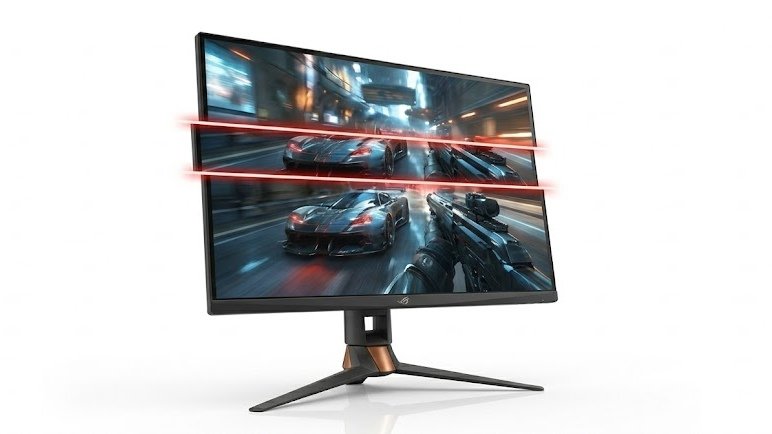
If you have ever seen the top half of a game image suddenly slide sideways from the bottom half during fast camera movement, you have experienced screen tearing. It is one of the most distracting visual artefacts on any display, and it has frustrated gamers for decades. The good news is that tearing is well understood, and there are several reliable ways to eliminate it.

Contents
What Screen Tearing Looks LikeWhy Screen Tearing HappensSolution 1: V-SyncSolution 2: G-Sync and FreeSyncSolution 3: Frame Rate Cap Below Refresh RateSolution 4: High Refresh Rate MonitorsSolution 5: Fast Sync and Enhanced SyncWhich Solution Is Best for YouTest Your SetupConclusionDisclaimer

This article explains why tearing happens, when it is most likely to appear, and the practical ways to make it go away on any modern setup.

What Screen Tearing Looks Like
What Screen Tearing Looks Like

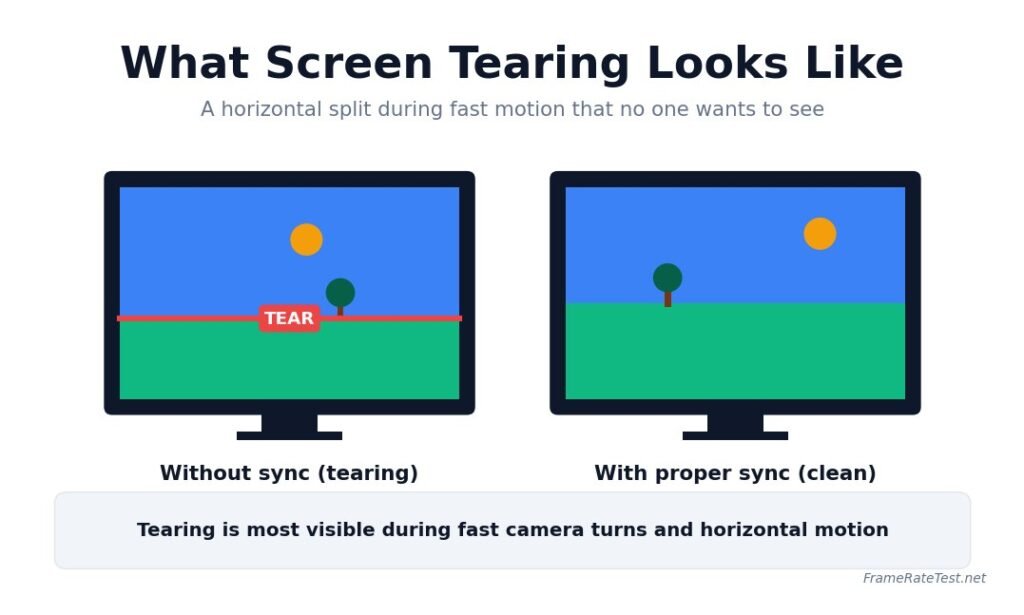
Tearing appears as a horizontal split across the screen during motion. The image above the line shows one frame, and the image below shows another. The split can move up and down rapidly, can appear in multiple places at once, and is most obvious during fast horizontal panning, fast camera turns, or scrolling text.

Why Screen Tearing Happens
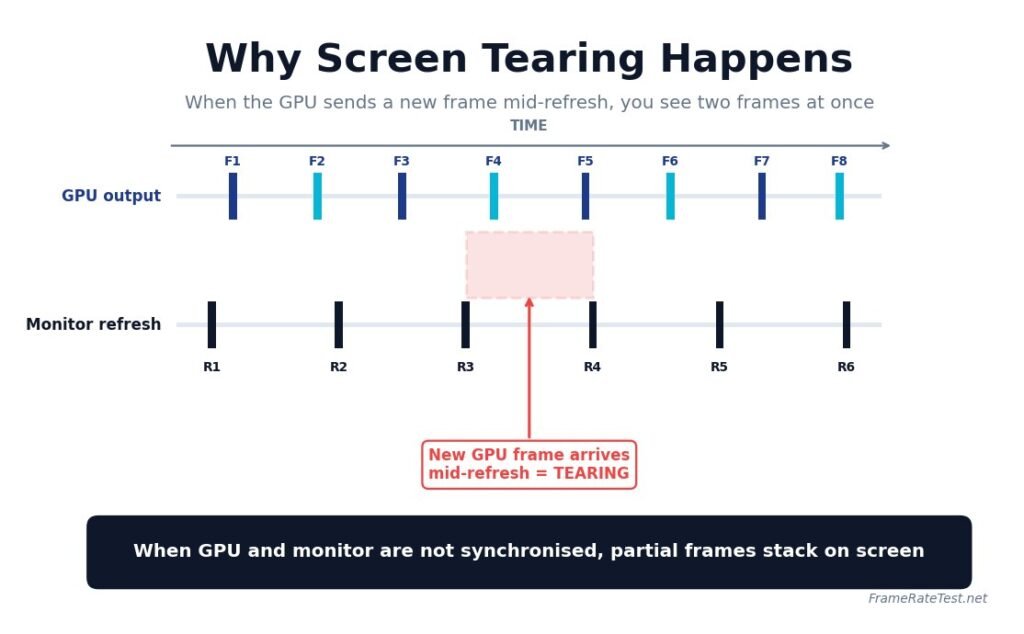
Why Screen Tearing Happens

Tearing occurs when your graphics card delivers a new frame to the monitor while the monitor is still drawing the previous frame. The result is two partially stitched frames visible together. This typically occurs when the frame rate (FPS) does not match the display’s refresh rate (Hz). The Wikipedia article on screen tearing gives a clear technical explanation of the underlying mismatch.

It is most noticeable when the frame rate is significantly higher than the refresh rate, because more torn frames are produced per second. It can also appear when the frame rate is below the refresh rate, but less frequently.
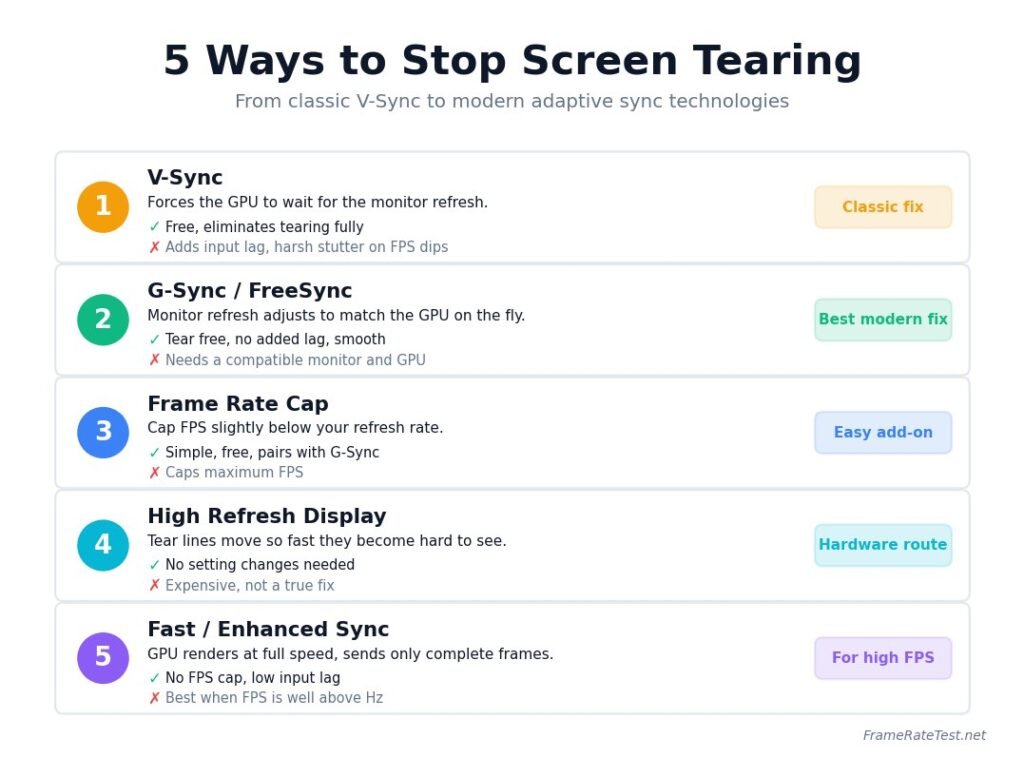
5 wayto stop screen tearing

Solution 1: V-Sync

Vertical Sync, also known as V-Sync, is the original solution for screen tearing. It forces the GPU to wait for the monitor to finish refreshing before sending a new frame. This eliminates tearing completely, but introduces two new problems. First, it caps your frame rate to the monitor’s refresh rate. Second, if your FPS drops below the refresh rate, V-Sync can cause stutter and add input lag.

V-Sync is still useful for casual single-player games where input lag does not matter. It is generally a poor fit for competitive multiplayer because of the added latency.

Solution 2: G-Sync and FreeSync

Adaptive sync technologies were designed to solve tearing without the downsides of V-Sync. NVIDIA G-Sync and AMD FreeSync let the monitor’s refresh rate vary on the fly to match the GPU’s frame rate. The result is smooth, tear-free motion with virtually no added input lag.

Most modern gaming monitors include FreeSync, G-Sync, or both. Many televisions sold for gaming also include adaptive sync over HDMI 2.1. To use it, enable the feature in both your graphics control panel and the monitor’s on-screen menu.

Solution 3: Frame Rate Cap Below Refresh Rate

A simple and effective approach is to cap your frame rate slightly below your refresh rate. For a 144Hz monitor, cap FPS at 141. This keeps the GPU in sync with the monitor without forcing the rigid lockstep of V-Sync, and pairs especially well with G-Sync or FreeSync. Most modern GPU control panels include a frame rate limiter.

Solution 4: High Refresh Rate Monitors

Higher refresh rate displays make tearing less visible because each torn frame is on screen for a shorter time. A 240Hz monitor with no sync technology will still tear, but the tear lines move so quickly that the eye has a harder time perceiving them. This is not a true fix, but it does reduce the perceptual impact.

Solution 5: Fast Sync and Enhanced Sync

Both NVIDIA and AMD offer alternatives to traditional V-Sync. NVIDIA’s Fast Sync and AMD’s Enhanced Sync allow the GPU to render frames at full speed and present only completed frames to the monitor when it is ready. NVIDIA Fast Sync explainer covers how this works in practice. These options work best when your frame rate is well above your refresh rate.
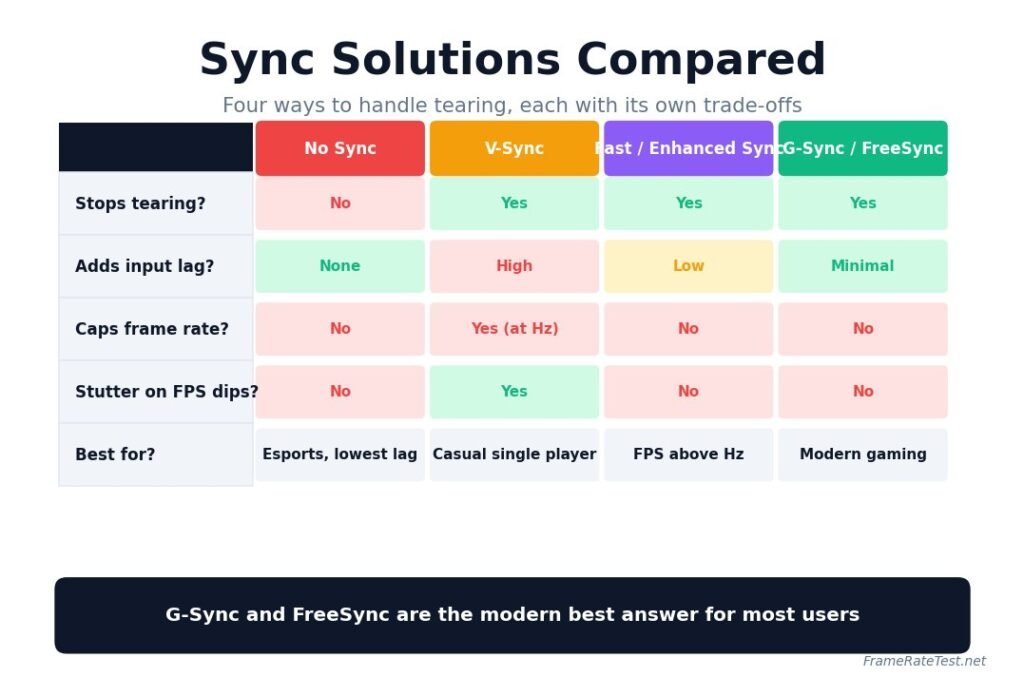
Sync Solution Compared

Which Solution Is Best for You

Which Solution Is Best for You

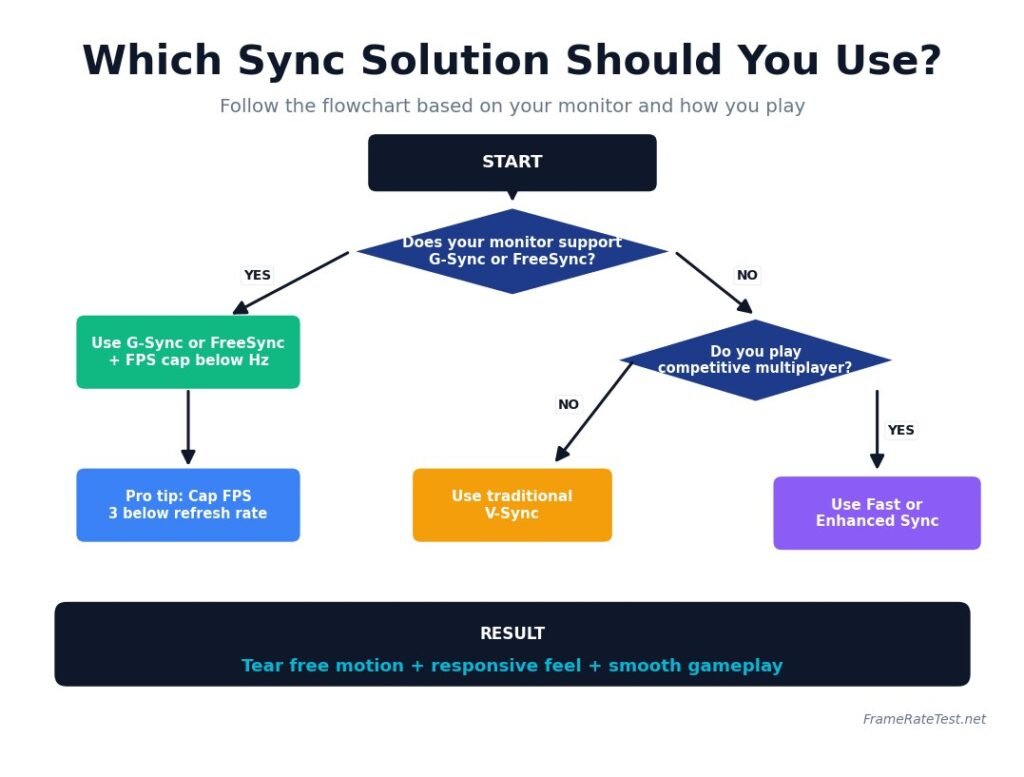
If you have a modern monitor with G-Sync or FreeSync, enable it. Pair it with a frame rate cap a few FPS below your refresh rate for the smoothest results. If your monitor does not support adaptive sync and you play single-player games, V-Sync is fine. If you play competitive multiplayer on a non-adaptive display, use Fast Sync or Enhanced Sync, or accept some tearing in exchange for the lowest possible input lag.

Test Your Setup

Run our frame rate test on FrameRateTest.net to see how many frames your browser produces, then compare that to your monitor’s refresh rate. If your FPS is much higher than your refresh rate, tearing is more likely. The tool also lets you increase rectangle speed so you can intentionally trigger tearing and confirm whether your sync setup is working.

Conclusion

Screen tearing has a clear cause and several reliable fixes. Adaptive sync technologies like G-Sync and FreeSync are the modern best answer for most users, while V-Sync still has its place in casual play. With the right combination of sync technology and frame rate management, you can enjoy completely tear-free motion without sacrificing the responsiveness that makes a high frame rate display feel so good in the first place.

Disclaimer

This article is provided for informational and educational purposes only. Frame rate, refresh rate, and hardware performance can vary widely depending on your device, drivers, browser, operating system, and background workload. Results from any browser-based testing tool, including the one on this site, are approximate and should be treated as a guideline rather than a precise hardware benchmark. Brand names, software, and products mentioned are the property of their respective owners and are referenced only for clarity. Always confirm settings and specifications with your device manufacturer before making purchasing or hardware decisions.

Share This Article
Facebook Twitter Email Copy Link Print
By Larry Lyons Gaming & Tech Reviewer
Follow:
Larry Lyons is a passionate gamer dedicated to helping fellow players improve their gaming experience through honest, practical performance insights.
Previous Article How to Check Your FPS on Windows, Mac, PlayStation, Xbox, Android, and More How to Check Your FPS on Windows, Mac, PlayStation, Xbox, Android, and More
Next Article V-Sync vs G-Sync vs FreeSync_ Complete Guide to Display Sync Technologies V-Sync vs G-Sync vs FreeSync: Complete Guide to Display Sync Technologies
Leave a comment Leave a comment

Leave a Reply Cancel reply

Your email address will not be published. Required fields are marked *

Most Popular

A Memoir of Soccer, Grit, and Leveling the Playing Field
10 Super Easy Steps to Your Dream Body 4X
Mind Gym : An Athlete's Guide to Inner Excellence
Mastering The Terrain Racing, Courses and Training
Is 144Hz Worth It in 2026? Honest Guide for Every Gamer

Is 144Hz Worth It in 2026? Honest Guide for Every Gamer

By Larry Lyons Gaming & Tech Reviewer

Subscribe Now

Subscribe to our newsletter to get our newest articles instantly!

[mc4wp_form]

What Is FPS? A Complete Beginner’s Guide to Frames Per Second

2 weeks ago

30 FPS vs 60 FPS vs 120 FPS vs 144 FPS vs 240 FPS Compared

2 weeks ago

You Might Also Like

V-Sync vs G-Sync vs FreeSync_ Complete Guide to Display Sync Technologies
Monitors & Display Tech

V-Sync vs G-Sync vs FreeSync: Complete Guide to Display Sync Technologies

2 weeks ago
60Hz vs 144Hz vs 240Hz Monitors: Which Refresh Rate Is Right for You?
Monitors & Display Tech

60Hz vs 144Hz vs 240Hz Monitors: Which Refresh Rate Is Right for You?

2 weeks ago
Frame Rate Test — Free FPS, Monitor and Mouse Testing Tools

Test your device’s frame rate (FPS) and refresh rate online with our free Frame Rate Test tool. Measure FPS, monitor Hz, smoothness, and performance instantly.

100% Free No Install All Devices No Sign-Up
Email Us info@frameratetest.net
Our Office
77 Sands Street, 6th Floor
New York, NY 11201
Testing Tools
  • Frame Rate Test
  • FPS Test
  • Refresh Rate Test
  • Display Test
  • Screen Bleeding Test
  • Dead Pixel Test
  • Dead Pixel Fixer
  • Stuck Pixel Identifier
  • PPI Calculator
Input Tools
  • Mouse Polling Rate Test
  • Mouse DPI Analyzer
  • Mouse Scroll Wheel Test
  • Keyboard Tester
  • Spacebar Clicker
  • Click Speed Test
  • Gamepad Tester
  • Touchscreen Test
  • Latency Reaction Time Test
Company
  • About Us
  • Contact Us
  • Support
  • Blog
Popular Links
  • Home
  • Click Speed Test
  • Gamepad Tester
  • PPI Calculator

© 2026 frameratetest.net — All rights reserved. Free tools to test FPS, refresh rate, mouse DPI and more.

Privacy Policy Terms of Service Cookie Policy DMCA
Welcome Back!

Sign in to your account

Lost your password?